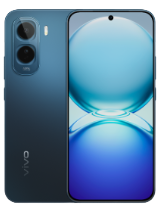
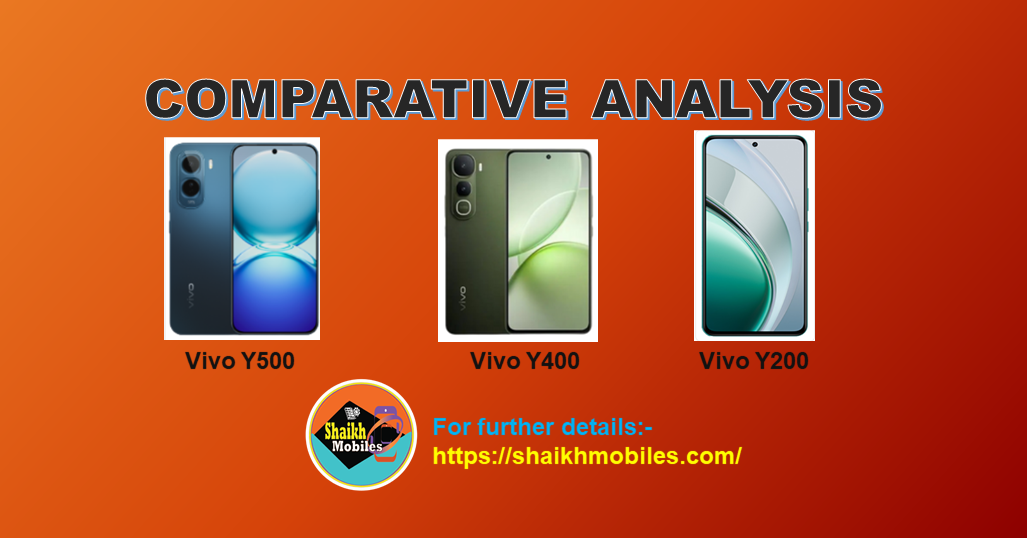
This review compares Vivo Y500, Vivo Y400 and Vivo Y200.
Following comparision of individual specification i.e design, displays, cameras, hardware, battery and benchmark values make it realized that how new mobiles models are introduced with some upgrades.
📱 Design & Display
| Model | Display | Special Features |
|---|---|---|
| Vivo Y500 | 6.83 inches — Infinity AMOLED Display, Capacitive multi-touch | 5000 nits, 449 PPI, Q10+; AMOLED, IP68/IP69 |
| Vivo Y400 | 6.67 inches, 107.4 cm2 — AMOLED, 120Hz, 1200 nits (HBM), 1800 nits | MIL-STD-810H compliant** does not guarantee ruggedness or use in extreme conditions; IP69 dust tight and water resistant (high pressure water jets; immersible up to 2m for 30 min) |
| Vivo Y200 | 6.67 Inches — AMOLED Capacitive Touchscreen | 120Hz, 800 nits (peak); 0 |
Analysis: All models listed fall into a similar 6.5–6.9″ class as shown in specifications, which places them in the same mainstream phablet category.
Models that include refresh-rate notes (for example, 90Hz or 120Hz) prioritize smoother UI motion and scrolling fluidity when paired with a capable GPU.
Entries that list screen protection or IP ratings indicate a durability advantage for outdoor usage and accidental exposure to water/splashes. specifications do not provide color calibration or HDR measurements for all models, so perceived vibrancy and contrast require hands-on verification.
📸 Camera Comparison
| Model | Rear Camera (primary) | Front Camera | Video |
|---|---|---|---|
| Vivo Y500 | 50 MP Sony Camera2 MP | 32 MP | 4K@30fps, 1080p@30fps |
| Vivo Y400 | 50 MP, f/1.8, (wide), 1/2.96″, PDAF2 MP, f/2.4, (depth) | 32 MP | 1080p@30fps |
| Vivo Y200 | Dual Camera: 50 MP + 2 MP, LED Flash | 32 MP |
Analysis: Vivo Y500 lists its primary camera as 50 MP Sony Camera2 MP. Vivo Y400 lists its primary camera as 50 MP, f/1.8, (wide), 1/2.96″, PDAF2 MP, f/2.4, (depth).
Vivo Y200 lists its primary camera as Dual Camera: 50 MP + 2 MP, LED Flash. Higher stated pixel counts or PDAF suggest potential for better detail capture on paper, but sensor size and processing strongly influence final image quality.
Several models include explicit video capability fields (frame rates or resolutions), which informs expected recording capability. Because hardware and feature claims only, practical imaging results (noise, dynamic range, stabilization) must be confirmed via real-world testing.
⚡ Performance & Hardware
| Model | Chipset | CPU / GPU | RAM | Benchmark |
|---|---|---|---|---|
| Vivo Y500 | UnisocT7300 | Octa-core (2x Cortex-A78 @ 2.2GHz, 6x Cortex-A55 @ 2.0GHz) / Mali-G57 MC2 | 8 GB | 510,000 • ~683 / ~1,968 |
| Vivo Y400 | Snapdragon 685 | Octa-core (2×2.2 GHz Cortex-A78 & 6×1.95 GHz Cortex-A55) / Adreno 613 | 8 GB | 348982 • 473 / 1,510 |
| Vivo Y200 | Qualcomm Snapdragon 685 | Octa-core (4 × 2.8 GHz + 4 × 1.9 GHz) / Adreno 610 | 8 GB | 349440 • 473 / 1510 |
Analysis: The chipset dataset, Vivo Y500 shows the highest reported Antutu figure (510,000 as listed), which on paper indicates greater CPU/GPU throughput. Chipset family (e.g., Helio, Snapdragon) help place devices into performance tiers and hint at GPU capability for gaming or high-refresh displays. Benchmark results are reproduced verbatim and are not independently validated here; thermals, sustained performance and real-world frame rates require hands-on profiling.
🔋 Battery & Charging
| Model | Battery | Charging |
|---|---|---|
| Vivo Y500 | 8100 mAh BlueVolt Battery | 44W Fast Charging |
| Vivo Y400 | Li-Ion 6000 mAh | 90W wired, 50% in 20 minReverse wiredBypass Charging |
| Vivo Y200 | (Li-ion Non removable), 5000 mAh | 0 |
Analysis: As mentioned above, Vivo Y500 lists the largest battery capacity (8100 mAh BlueVolt Battery), which typically translates into longer on-paper endurance if software power management is comparable. Where charging wattage is listed (for example, 18W/33W/45W), that materially affects recharge speed and user convenience. The sepcificaitons do not measure charging efficiency or heat; real charging times and endurance should be verified with battery tests.
💾 Storage & Memory
| Model | Storage | RAM |
|---|---|---|
| Vivo Y500 | 128 GB (UFS 2.2) | 8 GB |
| Vivo Y400 | 128/256GB (UFS 3.1) | 8GB |
| Vivo Y200 | 128GB Built-in (UFS 2.2) | 8GB RAM |
Analysis: Storage and RAM variants; models listing UFS vs eMMC types indicate potential differences in sustained IO and app load responsiveness. Expandable storage support (microSD) where listed provides added flexibility for users with high media needs.
🌐 Connectivity & Features
- Vivo Y500: WLAN: 2.4 GHz / 5 GHz; BLUETOOTH: Bluetooth 5.4; NFC: Not supported; USB: USB 2.0; SENSORS: In-display optical fingerprint sensor; SIM: 2 nano SIMs (Dual SIM Dual Standby (DSDS)
- Vivo Y400: WLAN: Wi-Fi 802.11 a/b/g/n/ac, dual-band; BLUETOOTH: 5.0, A2DP, LE; NFC: No; USB: USB Type-C 2.0, OTG; SENSORS: Fingerprint (under display, optical), accelerometer, gyro, proximity; SIM: Nano-SIM + Nano-SIM
- Vivo Y200: WLAN: Wi-Fi 802.11 a/b/g/n/ac, dual-band; BLUETOOTH: v5.0 with A2DP, LE; NFC: No; USB: USB Type-C 2.0, OTG; SENSORS: Accelerometer, Compass, Fingerprint (under display, optical), Gyro, Proximity; SIM: Dual Sim, Dual Standby (Nano-SIM)
✅ Pros ✔ & ❌ Cons ✔
- Vivo Y500 — Pros ✔
- Battery: 8100 mAh BlueVolt Battery.
- Benchmarks (Antutu: 510,000).
- Display: Infinity AMOLED Display, Capacitive multi-touch.
- Specs should be verified in hands-on testing for imaging & battery behavior.
- Vivo Y400 — Pros ✔
- Battery: Li-Ion 6000 mAh.
- Benchmarks (Antutu: 348982).
- Display: AMOLED, 120Hz, 1200 nits (HBM), 1800 nits.
- Specs should be verified in hands-on testing for imaging & battery behavior.
- Vivo Y200 — Pros ✔
- Battery: (Li-ion Non removable), 5000 mAh.
- Benchmarks (Antutu: 349440).
- Display: AMOLED Capacitive Touchscreen.
- Specs should be verified in hands-on testing for imaging & battery behavior.
🔍 Conclusion
The above dataset and entries suggest distinct priorities across models: Vivo Y500 appears focused on battery capacity according to the above details. Vivo Y500 ranks highest by reported benchmarks and appears strongest on paper for performance. These observations should guide hands-on testing and final editorial recommendations.