
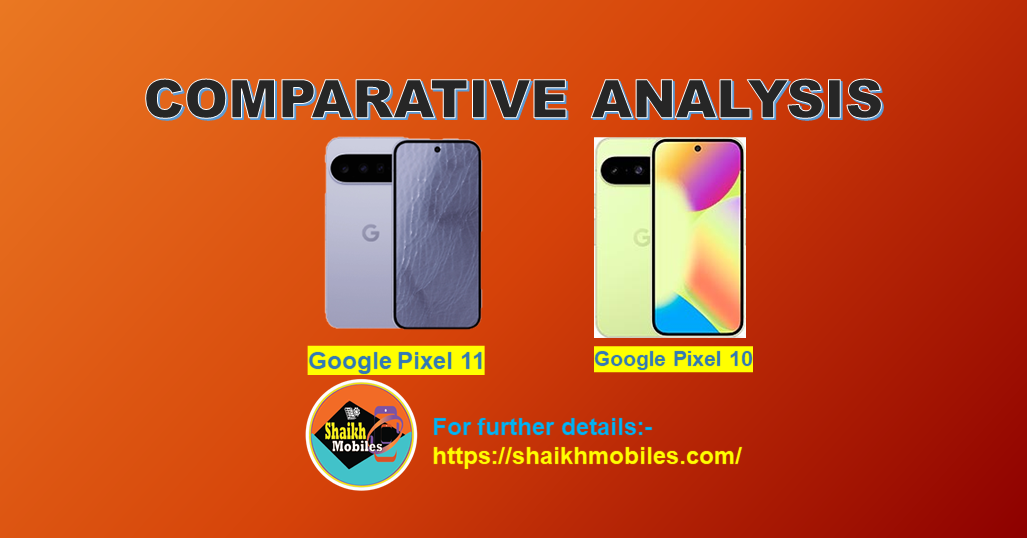
This comparative review compares Google Pixel 11 and Google Pixel 10 for making it realized how google has upgraded its device and launched new version, while offering update of sofware services and upgrade of hardware.
Following comparision of individual specification i.e design, displays, cameras, hardware, battery and benchmark values make it realized that how new mobiles models are introduced with some upgrades.
📱 Design & Display
| Model | Display | Special Features |
|---|---|---|
| Google Pixel 11 | 6.3-inch — OLED Display | 120Hz, up to 3000 nits, 24-bit depth for 16 million colors Corning® Gorilla® Glass Victus® 2 cover glass, IP68 dust and water resistance |
| Google Pixel 10 | 6.3 inches Super Actua display | Upto 120Hz, 2000 nits (HDR) and up to 3000 nits (peak brightness); Corning Gorilla Glass Victus 2, Mohs level 4 |
Analysis: Both models fall into a similar 6.5–6.9″ class as shown in specifications, which places them in the same mainstream phablet category.
They include refresh-rate notes (120Hz) prioritize smoother UI motion and scrolling fluidity when paired with a capable GPU.
Entries that list screen protection or IP ratings indicate a durability advantage for outdoor usage and accidental exposure to water/splashes.
specifications do not provide color calibration or HDR measurements for all models, so perceived vibrancy and contrast require hands-on verification.
📸 Camera Comparison
| Model | Rear Camera (primary) | Front Camera | Video |
|---|---|---|---|
| Google Pixel 11 | 48 MP wide Macro Focus, 13 MP ultrawide, 10.8 MP 5x telephoto lens | 10.5 MP Dual PD selfie camera | 4K video recording at 24/30/60 FPS |
| Google Pixel 10 | 48 MP, 13 MP, 10.8 MP | 10.5 MP Dual PD selfie camera with autofocus | 4K@30/60fps, 1080p@30/60fps |
Analysis: Google Pixel 11 lists its primary camera as 48 MP wide Macro Focus, 13 MP ultrawide, 10.8 MP 5x telephoto lens. Google Pixel 10 also offerred camera with about same specifications.
Several models include explicit video capability fields (frame rates or resolutions), which informs expected recording capability. Because hardware and feature claims only, practical imaging results (noise, dynamic range, stabilization) must be confirmed via real-world testing.
⚡ Performance & Hardware
| Model | Chipset | CPU / GPU | RAM | Benchmark |
|---|---|---|---|---|
| Google Pixel 11 | Google Tensor G6 with Titan M3 security coprocessor | 7-core (1x C1-Ultra @ 4.11 GHz, 4x C1-Pro @ 3.38 GHz, 2x C1-Pro @ 2.65 GHz) / IMG CXTP-48-1536 | 12 GB | 1,933,536 • ~2,755 / ~7,563 |
| Google Pixel 10 | Google Tensor G5 (3 nm), Titan M2 security coprocessor | Octa-core (1×3.78 GHz Cortex-X4 & 5×3.05 GHz Cortex-A725 & 2×2.25 GHz Cortex-A520) / PowerVR DXT-48-1536 | 12 GB | ~1,800,000 • ~2200 / ~7500 |
Analysis: The chipset dataset, Google Pixel 11 shows the highest reported Antutu figure (1,933,536 as listed), which on paper indicates greater CPU/GPU throughput.
Chipset family (Google Tensor) comes with special security chips which help place devices into performance tiers and hint at GPU capability for gaming or high-refresh displays.
Benchmark results are reproduced verbatim and are not independently validated here; thermals, sustained performance and real-world frame rates require hands-on profiling.
🔋 Battery & Charging
| Model | Battery | Charging |
|---|---|---|
| Google Pixel 11 | Typical 4985 mAh (minimum 4840 mAh) | 30W wired and 25 W wireless |
| Google Pixel 10 | Li-Ion 4970 mAh | 30W wired and 15W wireless |
Analysis: As mentioned above, Google Pixel 11 lists a bit larger battery capacity (Typical 4985 mAh (minimum 4840 mAh)), which typically translates into longer on-paper endurance if software power management is comparable.
Where both offering 30W wired and 25 W wireless charging, that materially affects recharge speed and user convenience.
The sepcificaitons do not measure charging efficiency or heat; real charging times and endurance should be verified with battery tests.
💾 Storage & Memory
| Model | Storage | RAM |
|---|---|---|
| Google Pixel 11 | 256 / 512 GB (Zoned UFS, UFS 4.x) | 12 GB |
| Google Pixel 10 | 128 / 128GB , 256GB UFS 3.1 or 2.2 | 12 GB |
Analysis: Storage and RAM variants; models listing UFS versions which indicate potential differences in sustained IO and app load responsiveness.
Expandable storage support (microSD) where listed provides added flexibility for users with high media needs.
🌐 Connectivity & Features
- Google Pixel 11: WLAN: Wi-Fi 6E (802.11ax); BLUETOOTH: Bluetooth® v6 with antenna diversity for enhanced quality and connection; NFC: Supported; USB: USB Type-C 3.2; SENSORS: Under display, ultrasonic Finger scanner; SIM: eSIM + eSIM (8 or more, max 2 at a time; USA)
- Google Pixel 10: WLAN: Wi-Fi 802.11 a/b/g/n/ac/6e, dual-band; BLUETOOTH: 6.0, A2DP, LE, aptX HD; NFC: Yes; USB: USB Type-C 3.2; SENSORS: Fingerprint (under display, ultrasonic), accelerometer, gyro, proximity, compass, barometer; SIM: Nano-SIM + eSIM· eSIM + eSIM
✅ Pros ✔ & ❌ Cons ✔
- Google Pixel 11 — Pros ✔
- Battery: Typical 4985 mAh (minimum 4840 mAh).
- Benchmarks (Antutu: 1,933,536).
- Display: OLED Display.
- Specs should be verified in hands-on testing for imaging & battery behavior.
- Google Pixel 10 — Pros ✔
- Battery: Li-Ion 4970 mAh.
- Benchmarks (Antutu: ~1,800,000).
- Display: Corning® Gorilla® Glass Victus® 2 cover glass, Super Actua display.
- Specs should be verified in hands-on testing for imaging & battery behavior.
🔍 Conclusion
The above dataset and entries suggest distinct priorities across models: Google Pixel 11 appears focused higher performance updated enhanced security. These observations should guide hands-on testing and final editorial recommendations.